HISTORY
1. In February, 1898 Camp Thomas, named for General George H. Thomas, the “Rock of Chickamauga”, was created to meet the needs of the Spanish-American War. Over 7,000 regular army infantry, cavalry and artillery units were stationed here from April 14 to May 14, 1898. Camp Thomas began closing in August 1898.(1)
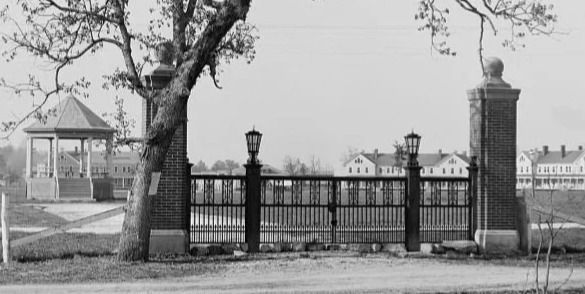
2. In 1902, 810 acres were secured just north of the Military Park and construction was begun on Chickamauga Park (North Post). It included officers’ quarters, barracks and stables, parade grounds, hospital and support buildings.
3. President Theodore Roosevelt visited the cavalry post in 1903 while it was under construction.(1)
4. The post was dedicated December 27, 1904 and named “Fort Oglethorpe” for the founder of the Georgia colony and the first Governor of Georgia, James Oglethorpe.(1)
5. Said to be the “largest and finest” cavalry post in the United States, Fort Oglethorpe Post, upon dedication in 1904, consisted of 74 buildings costing from $2,000 to $64,000 each to construct (2) and had a total construction cost of $1,000,000.(8) It accommodated (in 1904) 50 commissioned officers, 1,200 enlisted men and 1,500 horses.(2)
6. Fort Oglethorpe made its first valuable contribution to mechanized war in 1917 when tank experiments were conducted and later a regiment from the post became the first American tank unit in Europe.(8)
7. March 7, 1916: A bill to enlarge Fort Oglethorpe Cavalry Post to a Brigade Post was passed by Congress. A sum of $1,540,420 was awarded for this enlargement of the post.(17)
8. April 21, 1917: To prepare for an additional Training School at Fort Oglethorpe, the army ordered 81 buildings, quarters for 2,500 U.S. army reserve officers and applicants for reserve officers’ commission, erected on Snodgrass Hill and in full use in two weeks time.(15)
9. August, 23, 1917: The largest review of army medical units ever held in the United States, over 4,000 men, took place on McDonald Field at Fort Oglethorpe. In the line of march were 1,060 medical officers, more than twice the number ever in the medical corps of the army before, and 3,232 enlisted men(16)
10. The first sanitary companies and the first evacuation hospital units in military history were organized at Fort Oglethorpe’s Camp Greenleaf in 1917 under the command of Col. Henry Page.(26)
11. Camp Greenleaf Medical Training Center opened in May, 1917 and was said to be the “World’s Largest Army Medical Training Camp”. It was named after the Medical Corps pioneer, Brigadier General Charles R. Greenleaf. From June, 1917 to November, 1918, over 60,000 troops had passed through Camp Greenleaf.(3)(23)(24)
12. At Camp Greenleaf the School of Applied Surgical Mechanics started instruction in November, 1917, and other schools dealing in dentistry, nutrition, anatomy, plastic and oral surgery, urology, ophthalmology, psychology, surgery, neurosurgery, veterinary medicine, and roentgen logy soon followed. The School of Gas Defense also opened in November, 1917 and a meteorological station was established early in 1918 at Camp Greenleaf.(19)
13. During the dedication ceremony of the Warden McLean Auditorium on Camp Greenleaf in March, 1918, some of the notable attendees were Surgeon-General Gorgas, Dr. Franklin Martin, a member of the Advisory Commission Council of National Defense and Chairman General Medical Board; Dr. Charles Mayo, President of the American Medical Association; Dr. Arthur Dean Bevan, President-elect of the American Medical Association; and Dr. William Welch of Johns Hopkins University Medical School (20)
14. During WWI Fort Oglethorpe and Chickamauga Park were used for the mobilization and training of 75,000 – 80,000 soldiers. By 1918 there were 1,638 structures erected in Fort Oglethorpe Post and on land borrowed from the Chickamauga Chattanooga National Military Park.(19)
15. Also during WWI, Fort Oglethorpe housed a Prisoner of War Camp for German detainees, one of which was famed leader of the Boston Symphony, Dr. Karl Muck, who was arrested on March 25, 1918 on charges of being a spy. Dr. Muck formed an orchestra while at Ft Oglethorpe and Chattanoogans occasionally lined their automobiles along the road to hear it. Also imprisoned at Fort Oglethorpe were twenty-nine of Dr. Muck’s fellow German members of the Boston orchestra and former Cincinnati Symphony Orchestra conductor Earnest Kunwald. Dr. Muck was deported to Germany in late August, 1919 and never returned to the U.S. again. He died in Stuttgart, Germany, on March 4, 1940 at the age of 80.
16. Ft Oglethorpe’s WWI P.O.W. Camp was “the largest war prison barracks in the United States”. It was commanded by Colonel Charles Penrose. Under his command, it was said that approximately 5,000 alien enemies, mainly Germans, were interned at the Fort Oglethorpe during WWI. (10) The P.O.W. Camp was larger than both Camp Douglas and Camp McPherson combined. Fort Oglethorpe’s War Prison Guard peaked 400 men strong during this time.(4)(5)(27)
17. The German P.O.W. inmates wrote, illustrated, printed and distributed their own newsletter called, Orgelsdorfer Eulenspiegel, during their detainment at Fort Oglethorpe in 1918 and 1919.(6)
18. WWI, for the U.S., started April 6, 1917 and lasted until November 11, 1918. During this time, the casualties among American soldiers totaled 350,000.
19. After WWI, the cantonments adjacent to Fort Oglethorpe proper were sold by the government to the American House Wrecking Company of Chicago. It was reputed to be one of the largest wrecking concerns in the world with 1,200 buildings to be demolished. The wrecking company stated that the lumber alone, if loaded on freight cars, would make a train nearly five miles long. In addition to the lumber, there was a great quantity of other material, such as 300 miles of copper wire, 32 miles of pipe, 11 carloads of toilets, enough roofing paper to cover Market Street from curb to curb for nine miles, enough cooking ranges to feed 60,000 men, and enough heating apparatus estimated to keep warm 75,000 people. The wreckers declared if all the one-inch planks were laid on the ground, end to end, they would reach from Chattanooga to Chicago, then on to New York; and if the dimension lumber were added, the lumber line would extend back to Chattanooga.(13)
20. In 1936 Fort Oglethorpe was headquarters for the District “C” Unit of the Civilian Conservation Corps, with 68 Civilian Conservation Camps of 13,385 men, the largest in the United States.(21)
21. During WWII, there were, at one time, 90,000 trainees at Fort Oglethorpe and throughout Chickamauga Park.(9)
22. The 6th Cavalry Regiment moved to Fort Oglethorpe in July, 1919 and stayed until 1942, upon which it was relocated to South Carolina, taking with it 500 vehicles and no horses.(1)
23. The WAC (Women’s Auxiliary Corps) Training Center officially opened in February, 1943 with a live broadcast over the NBC Radio Network from Chickamauga Park. It was the largest unit trained at Fort Oglethorpe with nearly 50,000 women trained from 1943-1945.(1)(19)
24. The 1945 movie “Keep Your Powder Dry”, starring Lana Turner depicted life as a WAC. Portions of the movie were filmed at Fort Oglethorpe Post and Chickamauga Chattanooga National Military Park.
25. Lt.-Col. Elizabeth Strayhorn, Nashville-born WAC officer, was awarded the title of Post Commandant of the WAC Training Center at Ft Oglethorpe on April 22, 1944, becoming the 1st woman in U.S. history to command a post.(14)
26. Parts of the battlefield were used as experimental proving grounds for tanks and other weapon systems. The “bantam cars” (Jeeps) were tested here in Chickamauga Creek and in area lakes.(1)
27. President Franklin. D. Roosevelt visited the Post April 7, 1943 and reviewed the WACs on the parade grounds.(1)
28. The WAC Training Center officially opened in 1943 with a live broadcast over the NBC Radio Network from Chickamauga Park. It was the largest unit trained at Fort Oglethorpe with nearly 50,000 women trained from 1943- 1945, including the famous 6888th Battalion. The 824 women who made up the 6888th, the only all-Black, all-female battalion to serve overseas during WWII, stood together for the first time as an official unit in the polo field at the center of Fort Oglethorpe’s Officers’ Row. The trailblazing unit received the Congressional Gold Medal in 2025.(1)(19)(28)(29)
29. By 1946 the Army had determined the post could not be enlarged for future use and the property was declared surplus. The land and structures were sold to the public.(1)(19)
30. The installation of Ft Oglethorpe’s South Post, alone, cost the Federal Government some $2,000,000.(9)
Thanks to the continuous work by the Fort Oglethorpe Preservation Society, Fort Oglethorpe’s historic district, including Barnhardt Circle, the Officer’s Row of Fort Oglethorpe Post, was placed on the National Register of Historic Places in May of 1979.(18)
Sources
(1) www.gatewaytogeorgia.com Catoosa County Chamber of Commerce (2) author unknown, “The New Cavalry Post at Chickamauga Park”, Chattanooga Times 01/24/1904 (3) author unknown, “Looking Backward”, Chattanooga Times 05/05/1943: p.6 (4) author unknown, “War Prison Now Empty”, Chattanooga Times 04/28/1920: p.5 (5) author unknown, “Largest War Prison Barracks in U.S. May Soon Be Abolished”, Chattanooga News 05/20/1919: p.10 (6) copy of Orgelsdorfer Eulenspiegel donated to Chattanooga Bicentennial Library in 1999 (7) author unknown, “When Patriotism Flamed High”, Chattanooga Times/News 05/09/1937 p.8 (8) Sellers, Beryl, “Final ‘Taps’ at Fort Oglethorpe To End Service Covering 3 Wars”, Chattanooga Times 12/23/1946 p.13 (9) Hixson, Fred, “Army Is Denied Its South Post At Oglethorpe”, Chattanooga Times 02/22/1946 p.1 (10) author unknown, “Looking Backward”, Chattanooga Times 10/03/1945 p.6 (11) Browne, Vivian, “Bright Era To End With Fort Closing”, Chattanooga Times 12/26/1946 (12) author unknown, “Fort’s Cannon To Scrap Pile”, Chattanooga Times 09/11/1942 p.1 (13) author unknown, “Looking Backward”, Chattanooga Times 02/06/1945 p.6 (14) author unknown, “Lt.-Col. Strayhorn Named WAC Commandant at Post”, Chattanooga Times 04/23/1944 p.1 (15) author unknown, “81 Buildings for Officers”, Chattanooga Times 04/21/1917 p.5 (16) author unknown, “Thousands See Review”, Chattanooga Times 08/23/1917 p.5 (17) HEARINGS BEFORE A SUBCOMMITTEE OF THE COMMITTEE ON MILITARY AFFAIRS UNITED STATES SENATE: “ENLARGEMENT OF MILITARY POST OF FORT OGLETHORPE, GA” 64TH CONGRESS FIRST SESSION ON S.4312, 1916 (18) Walker, Linda Lee, “Fort Oglethorpe”, Chattanooga Times 06/10/1979 p.L1 (19) Chickamauga and Chattanooga National Military Park, http://www.nps.gov/archive/chch/adhi/adhi6a.htm, Medical Department, VII, 17, 26, 100, 108, 113, 116-21, 122, 124, 131-32, 137, 145, 149, 152, 153, 157-58, 160, 162, 163, 166, 167, 168, 169, 170, 172, 174. (20) author unknown, “Looking Backward”, Chattanooga Times 05/05/1943 p.6 (21)A. R. McKenzie, “Army and Navy Posts”, 01/25/1936 (22)author unknown, “First Anniversary of Women’s Army Auxiliary Corps”, 05/16/1943; Fort Des Moines Museum and Education Center at http://www.fortdesmoines.org/history.shtml, 03/20/2011 (23) 45. Gannon, "Fort Oglethorpe," p. 12; Quartermaster General to The Adjutant General, May 11, 1917. NA RG 94. AGO Documents, Box 8973, File 25295123; Catoosa County File, Georgia State Archives; General Orders and Bulletins, War Department, 1918 (Washington: Government Printing Officer, 1919), General Order 8, January 19, 1913. Medical Department of the United States Army in the World War (15 vols; Washington: Government Printing Office, 1927), VII (Training), pp. 1732; "Report of the Chickamauga and Chattanooga National Military Park Commission," in Annual Reports, War Department, 1917, p. 5; Gavan, The Chattanooga Country, p. 421. (24) "Report of the Chickamauga and Chattanooga National Military Park Commission, " in War Department Annual Reports, 1918. (Washington: Government Printing Office, 1919), p. 1461; Gannon, "Fort Oglethorpe," p. 12. (25) Regimental History, Sixth Cavalry Scrapbook. Chickamauga and Chattanooga National Military Park; Randolph to Quartermaster General, October 13, 1932. NA RG 79; Randolph to Quartermaster General, July 11, 1933, in ibid.; Gannon, "Fort Oglethorpe," pp. 16, 17. (26) Jean Grote, “Sixth Cavalry Lived Here 23 Years; PMG School at Post in 1942”, Chattanooga Times 07/28/1943 (27) author unknown, “Looking Backward”, Chattanooga Times 06/25/1944 p.18 (28)National Archives, www.archives.gov (29)WTVC,www.newschannel9.com